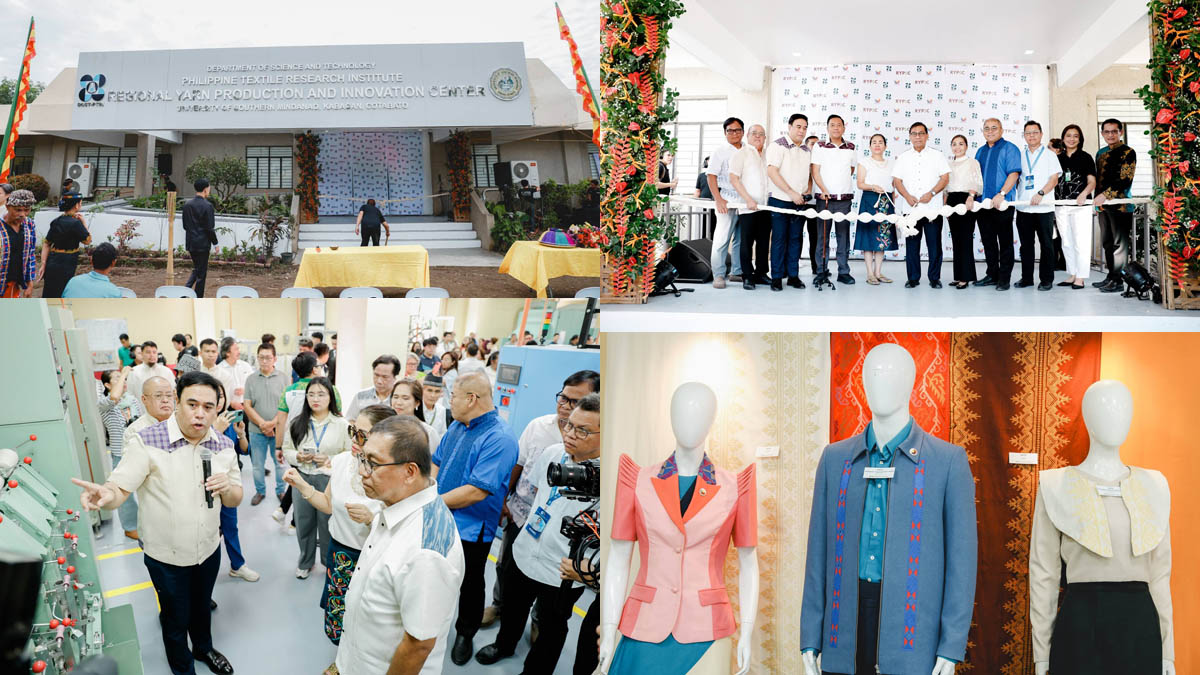
KABACAN, Cotabato – The Department of Science and Technology–Philippine Textile Research Institute (DOST-PTRI), in partnership with the University of Southern Mindanao (USM), officially launched the Regional Yarn Production and Innovation Center (RYPIC) in Kabacan, Cotabato on June 5, 2026, marking a significant milestone in the development of Mindanao’s textile industry.
As the first facility of its kind in Mindanao and the fourth in the country, RYPIC is expected to improve access to locally produced yarn, strengthen regional textile production, and create new economic opportunities for farmers, weavers, and rural communities across the island.
DOST Secretary Dr. Renato U. Solidum Jr. described the facility as a major step toward decentralizing innovation and bringing technology-driven development closer to communities. He noted that the establishment of RYPIC demonstrates the commitment of DOST-PTRI under the FRONTIER Program to strengthen local industries through regional innovation hubs, enabling communities to benefit directly from science and technology interventions.
The center addresses a growing demand for yarn in SOCCSKSARGEN, which DOST-PTRI data identifies as one of the country’s leading regions in handloom weaving communities and practicing weavers. Strategically located in Cotabato, the facility is positioned to serve weaving communities across SOCCSKSARGEN, Northern Mindanao, the Davao Region, and the Zamboanga Peninsula.
According to DOST-PTRI Director Dr. Julius L. Leaño Jr., the launch of RYPIC is not only about establishing infrastructure but also about developing a textile innovation ecosystem that connects fiber producers, yarn manufacturers, weavers, researchers, local governments, and industry stakeholders. He emphasized that the initiative combines technological innovation with the region’s rich textile traditions, creating a foundation for sustainable growth while preserving cultural heritage and supporting local livelihoods.
The facility is expected to become a critical link in the region’s growing textile value chain. Fiber sources include pineapple leaves from plantations in Polomolok, South Cotabato; abaca from Lake Sebu; and cotton from farms in Sarangani Province, all processed through the Natural Textile Fiber Innovation Hub in Tacurong, Sultan Kudarat.
By transforming agricultural by-products into valuable textile materials, the initiative promotes circular economy practices while opening additional income streams for farming communities. Farmers can now derive value not only from their primary agricultural products but also from materials that were previously considered waste.
DOST Undersecretary for Regional Operations Engr. Sancho A. Maborrang highlighted the broader socioeconomic impact of the facility, noting that its annual production capacity of approximately 13 tons of natural textile fiber blended yarns can help generate sustainable livelihood opportunities for rural communities throughout SOCCSKSARGEN and the rest of Mindanao. He underscored that the initiative demonstrates the growing competitiveness of Philippine natural textile fibers and their potential to meet both local and international market demands.
The project is expected to directly benefit farming groups such as the POLO Multi-Purpose Cooperative and Sta. Cruz Multi-Purpose Cooperative, while supporting approximately 1,982 handloom weavers across Mindanao through improved access to locally produced yarn.
Further strengthening the region’s textile industry, DOST-PTRI is also advancing the development of a bamboo textile fiber facility in Maramag, Bukidnon. The upcoming facility will process underutilized bamboo species into textile fibers, complementing the operations of RYPIC and expanding the range of sustainable raw materials available for yarn production.
Once fully operational, the center is projected to produce between 50 and 75 kilograms of yarn daily, equivalent to approximately 270 meters of handloom-woven fabric measuring one meter in width. With yarn valued at around ₱1,800 per kilogram, the facility is expected to generate between ₱25 million and ₱72 million in annual revenue while reducing dependence on imported yarn and stimulating greater weaving activity throughout Mindanao.
Through investments in regional innovation infrastructure, sustainable fiber development, and community-based production systems, RYPIC represents a significant step toward building a resilient Philippine textile industry that creates opportunities from farm to fabric while empowering communities across Mindanao. (NELSON SANTOS)